Timeline
The Swiss Federal Audit Office: and the story continues…
2024 : Fraudulent activities at RUAG MRO?
During an audit, the SFAO uncovers potential fraudulent activities at RUAG MRO. Among other things, a former senior manager sold spare parts for Leopard 1 tanks at prices allegedly below market value, resulting in a loss running into the high double-digit millions for RUAG MRO.
As early as 2016, the SFAO indicated that a system should be put in place to ensure compliance with the regulations and laws – which might have prevented the fraudulent activities. This case shows that robust regulations are important for preventing potential fraud, and that the SFAO’s recommendations in this regard must be taken seriously.
2021 : Transparency in political funding
On 18 June 2021, the Federal Assembly amends the Federal Act on Political Rights and establishes rules on transparency in political funding. This concerns the National Council and the Council of States elections, federal votes and the funding of the political parties represented in Parliament. Donations from abroad and anonymous donations are now prohibited. A year later, the SFAO is tasked to receive, verify and publish information provided by political actors. The new legal framework applies for the first time to the 2023 Federal elections.
In 2025, a study by the University of Bern, commissioned by the SFAO, shows that this enforcement task should not be the responsibility of the SFAO. It jeopardises the SFAO’s independence – and thus a central pillar of its work. The mandate of a supreme financial supervisory authority is to audit the expenditure of the Federal Administration, not the private funds of political actors. The SFAO is therefore calling for this task to be assigned to a new post.

2020: The COVID-19 crisis
Infections linked to the global COVID-19 pandemic exploded. On 13 March 2020, Switzerland went into lockdown. The SFAO revised its priorities: it supported the implementation of federal measures to cushion the economic and health consequences of the crisis and conducted preventive audits. This approach was not new and had been used in the past during the Swissair bailout. Several of the SFAO’s audits and data analyses focused on the measures taken to combat the consequences of the pandemic, in particular to prevent misuse and correct errors. In addition, the SFAO collected crisis-related reports on its whistleblower platform. The SFAO forwarded these to the State Secretariat for Economic Affairs, which was able to request the repayment of almost CHF 10 million by the end of 2021.
2015: More good news for the Swiss Confederation
On 2 October 2001, Swissair goes bankrupt. 14 years after Swissair went into receivership, the airline’s liquidator accepts the criticisms of the SFAO regarding the use of the Confederation’s loan. Result: CHF 220 million returns to the federal coffers.
2012: Good news for the Confederation
Audit work by the SFAO indicates non-compliant tax exemption for a multinational based in the Lake Geneva region. On 19 December 2012, the Brazilian mining group Vale International settles its tax dispute and refunds CHF 212 million to the Confederation and the canton of Vaud.

2006: No audit at SBC
Parliament adopts the completely revised Federal Act on Radio and Television (RTVA). As in its previous version from 1991, it excludes the Swiss Broadcasting Company (SRG SSR) from a financial audit by the SFAO unless the department responsible for the SRG SSR commissions the audit. The new version of the RTVA also tightens the conditions for such a mandate.
2005: The SFAO is audited
But the SFAO is also subjected to audit. The German Federal Audit Office carries out a peer review of the SFAO. Since then, the SFAO has commissioned further reviews: in 2009, the Norwegian Court of Auditors examined the SFAO’s evaluations and cross-sectional audits. The European Court of Auditors delivered its 2016 peer review on the topics of strategy, programme planning and quality control. In 2021, the French Cour des comptes focused its report on independence, communication, ethics and governance. In all cases, the results were positive and the SFAO has implemented all the recommendations.
2003: Warning!
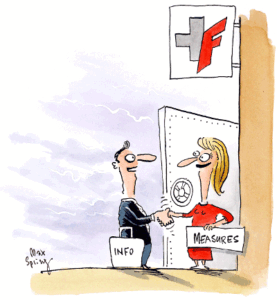
The Federal Council entrusts the SFAO with a new task. It is to gather the reported suspicions of federal administration whistleblowers.
2000: Matrix loaded
After more than one year of work with Gemini Consulting AG, the SFAO undergoes a reorganisation. The silo structure is discarded. The institution henceforward has a two-dimensional matrix structure. On the one hand, the assessment-focused areas mimic the organisation of the federal departments. On the other, the competence centres group the auditors by speciality (auditing, IT specialists, assessors, etc.). At the same time, the SFAO moves into new premises at 45 Monbijoustrasse, former home
of the Swiss Cheese Union.
1999: The Bellasi affair accounts
Following the embezzlement of funds by former Military Intelligence accountant Dino Bellasi, the Federal Council tasks the SFAO with analysing the payment operations of the Federal Department of Defence, Civil Protection and Sport. The Department’s financial management needs to be profession-alised. Thus, over 120 measures are proposed to improve payments processing and to apply the “four eyes” principle.
1998: A supreme external financial oversight body
The lessons of the FPF debacle inspire the drafting of a new version of the FAOA. On 22 June 1998, the Federal Council sends Parliament a dispatch aimed at institutionally strengthening the SFAO. The latter is to set its audit programme itself. It can refuse audit requests that threaten its ability to accomplish that programme. Its field of activity extends to companies in which the Confederation has a majority shareholding. Finally, communications and staffing policies are left in the hands of its director. Parliament approves this amendment. On 19 March 1999, the SFAO becomes “the supreme external financial oversight body”, subject only to the law and the Constitution.
1994: The SFAO strengthens its legal framework
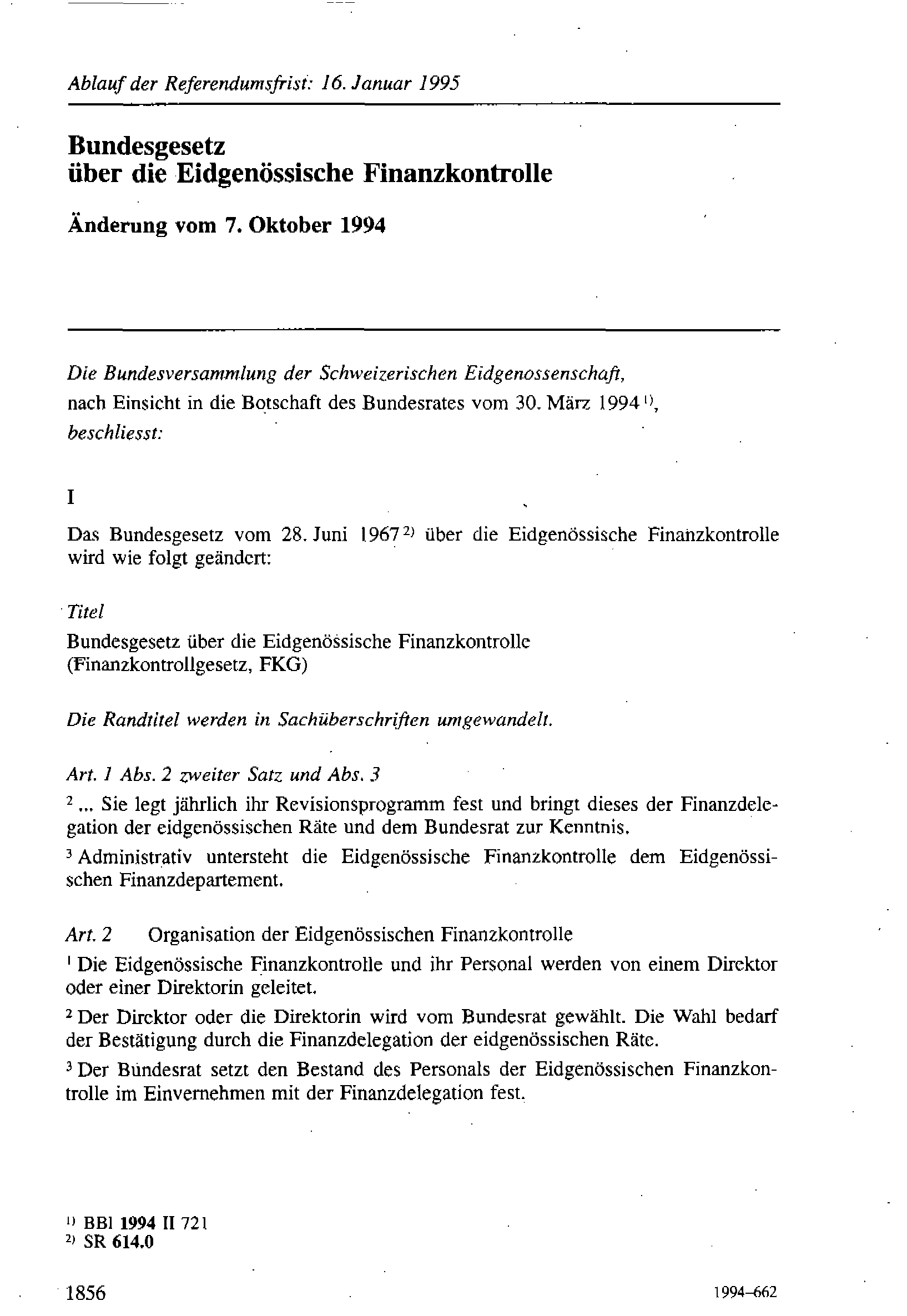
In the political turmoil of the 1990s, and within the logic of the INTOSAI international standards, the SFAO initiates with the FinDel a project of partly revising the law on which it is itself based. The proposal is supported by the finance committees, and the Federal Council is mandated to produce a draft. On 7 October 1994, Parliament approves the greater part of this revision. The independence of the SFAO is strengthened. It is a supreme external financial oversight body. Every year, it independently prepares its audit programme and publishes a report of its activities. The auditing criteria now include effectiveness. Finally, like the Swiss National Accident Insurance Fund, the SNB is now excluded from the SFAO’s audit scope. On the other hand, SBB are henceforth included within that scope.
1970: Modernising the SFAO
In May, the SFAO is reorganised. Since 1968, the new act has led to an increase in the number of audits. The SFAO spends 87% of its time countersigning records in the State Account and the payment or transfer orders before they are issued by the administration. Onsite audits therefore take up too little of its time. This worries the FinDel, which commissions an expert report from Professor Rudolf Probst. He recommends that more tasks be delegated from the SFAO to lower audit levels, that new divisions be created, and that its staff be professionalised. Shortly thereafter, two divisions appear on the SFAO’s organisational diagram: “Military Affairs and Acquisitions” and “Federal Grants and Buildings”. In July 1972, its staff receive the first edition of the auditing manual.
1967: A law for the SFAO
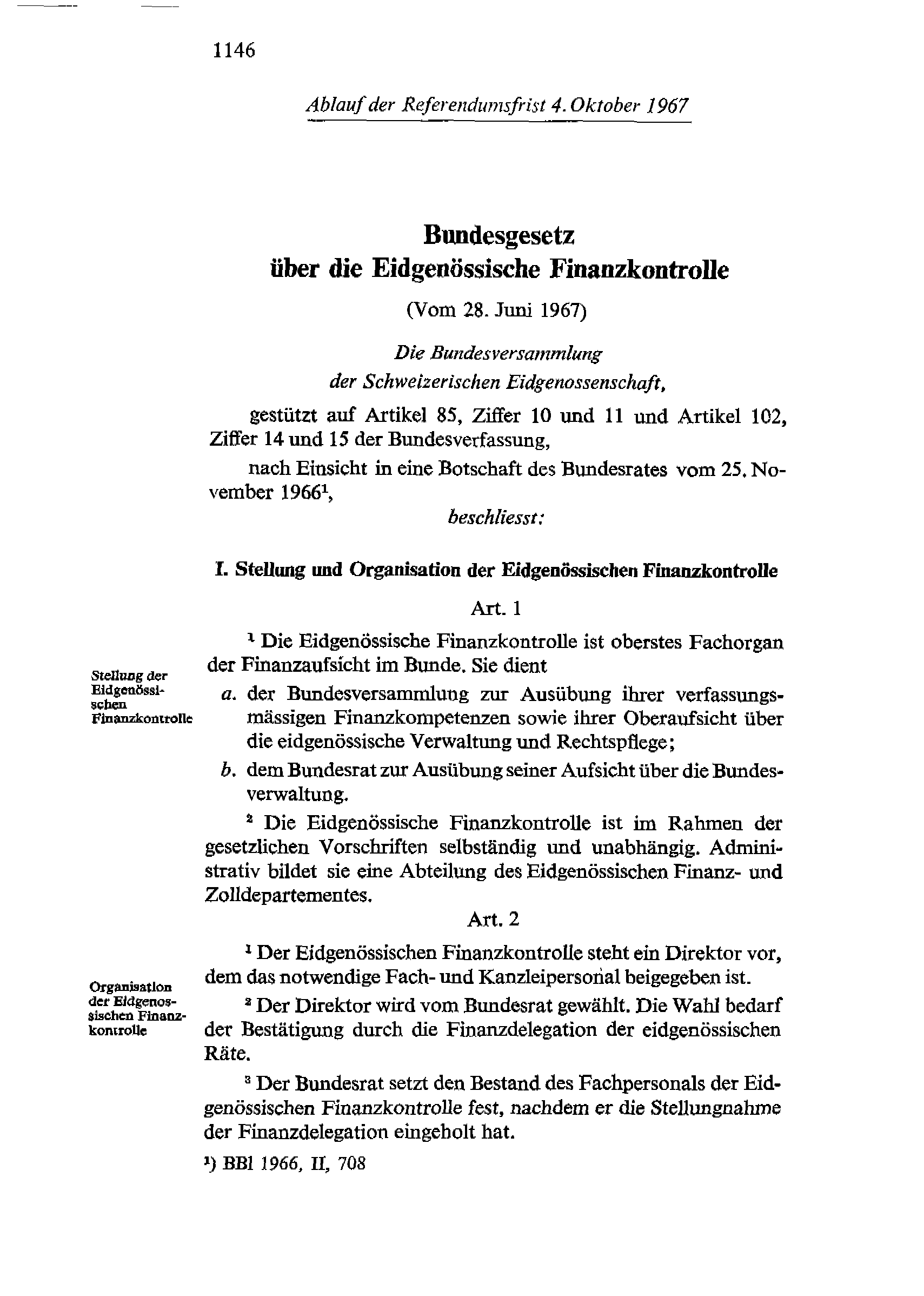
On 28 June 1967, Parliament approves the Federal Audit Office Act (FAOA). Its purpose is to provide support for the Federal Assembly in its financial oversight and for the Federal Council in its oversight of the administration. The SFAO ensures “the correct application of the law, the effective and sparing use of funds, and accurate bookkeeping”. Administratively, it remains a division of the Federal Department of Finance and Customs. Its autonomy grows and its relationship with Parliament becomes stronger. Its director is appointed by the Federal Council and must be confirmed by Parliament’s FinDel. Also appointed by the Executive, the secretary of FinDel and of the finance committees is attached to the SFAO. Staff numbers are set by the Federal Council after consultation with FinDel. The scope of its financial oversight extends to grants, purchases and buildings. On the other hand, neither SBB nor the Swiss National Accident Insurance Fund are included in its remit.
The FAOA comes into force on 1 January 1968.
1956: The existence of the SFAO requires a law
At the request of Armin Jeker, director of the SFAO, University of Bern law professor Rudolf Probst produces a report on the institution, its organisation and its methods. From the outset, this report rejects the notion of a Court of Auditors on the grounds that it would be ineffective. It proposes, however, to base the activities of the SFAO on a law rather than on a regulation. There is no clear boundary between the remits of the SFAO and those of the departmental auditing bodies. This leads to overlaps. The SFAO must be able to propose solutions directly to the Federal Council. A new organisation of this kind implies an increase in staff. After review by the finance committees and the FDF, the report is shelved and remains unpublished.

1953: The International Auditing Organisation
In Cuba, the International Organization of Supreme Audit Institutions (INTOSAI) is founded in November 1953. The SFAO joins at the beginning of the 1970s.
1939: Wartime auditors
On 26 September 1939, the Federal Council puts in place a group of auditors dedicated to the wartime economy. They constitute a new section of the SFAO, which will exist for the entire duration of the hostilities.
1924: A change of quarters
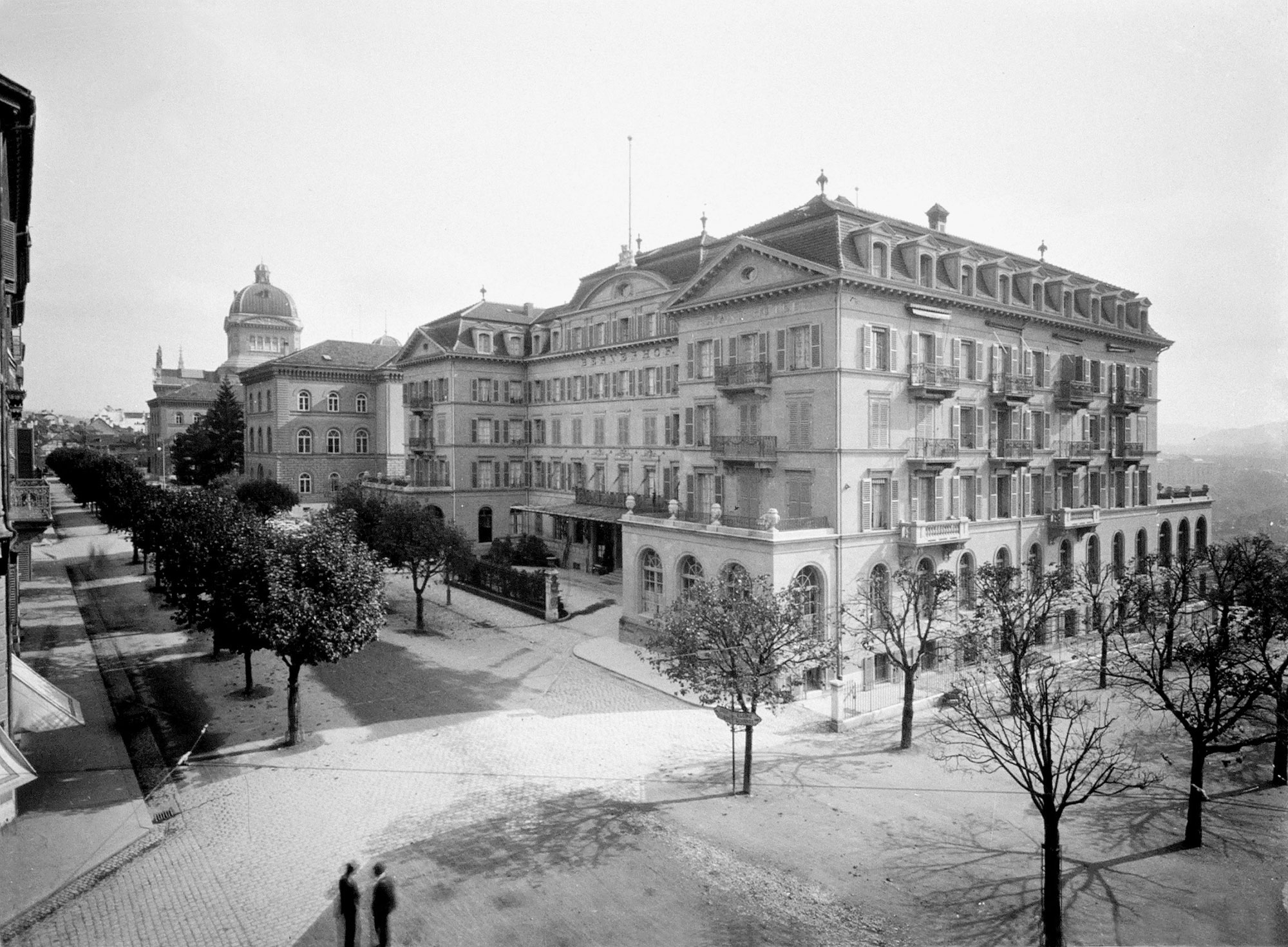
Das Eidgenössische Finanz- und Zolldepartement zieht in den Bernerhof, die EFK zieht mit.
1918: Audits delayed
The SFAO is affected by the influenza epidemic: it gives rise to over 500 days of staff absence. This delays the auditing of accounts by two years, much to Parliament’s displeasure.
1907: A new division of labour
With the creation of the Swiss National Bank (SNB), the SFAO is relieved of its auditing duties and responsibility as custodian and administrator of the Confederation’s securities portfolio.

1903: Working in concert with Parliament
On 24 February 1903, the first regulation governing the SFAO comes into force. Originating in a Department of Finance and Customs project of 29 November 1900, the text is jointly revised by the Federal Council and Parliament. Having been placed under the supervision of that department, the SFAO’s audit scope acquires a legal basis. Above all, the SFAO can “speak” to Parliament. The principle of an institution combining administrative audit and parliamentary audit is born. The SFAO is thus required to supply its information to the finance committees on demand. These committees are also assisted by SFAO staff.
1894: A change in the administration handbook
In the federal directory, the Audit Bureau is replaced by “Financial Audit”.

1877: The forerunner of the SFAO
On 19 February 1877, the Federal Council issues a regulation governing the Audit Bureau, at that time housed within the Department of Finance and Tolls. The Bureau is the forerunner of the SFAO. In reality, its creation is an internal reorganisation brought about by the need to audit the military tax and undertake auditing after infantry training is transferred to the Confederation. Moreover, the choice of what to audit is still influenced by the head of the Department, who has the right to issue instructions. The Audit Bureau is run by the former deputy head of the Finance Section of the same Department, Edmond de Grenus. Three staff members from the same Department move to the Bureau with him; only one employee comes from outside. A year later, the assistant of Edmond de Grenus transfers from auditing duties at the Higher War Commissariat. His name is Gustav Pillichody, and he will later become the third director of the Audit Bureau.
The first employees of the Audit Bureau
1852: An auditor for the federal accounts
The FFA staff regulations come into effect on 1 January 1852. They contain a reference to a permanent position of auditor of accounts.