The data mentioned in the following press release of 29 August 2025 has been updated in the electronic reporting register. The total receipts reported by 10 parties amounted to CHF 25.6 million (previously: 22.4 mn). The materially audited receipts totalled CHF 10.6 million (previously: 7.4 mn). Accordingly, the SFAO has updated the chart showing total receipts and the list of those subjected to a material audit.
Political parties in the Federal Assembly disclose their funding as of 30 June of the following year. The Swiss Federal Audit Office has today published the 2024 party funding figures in the electronic reporting register, together with a list of the audited political actors audited. The total receipts reported by 10 parties amounted to CHF 22.4 million.
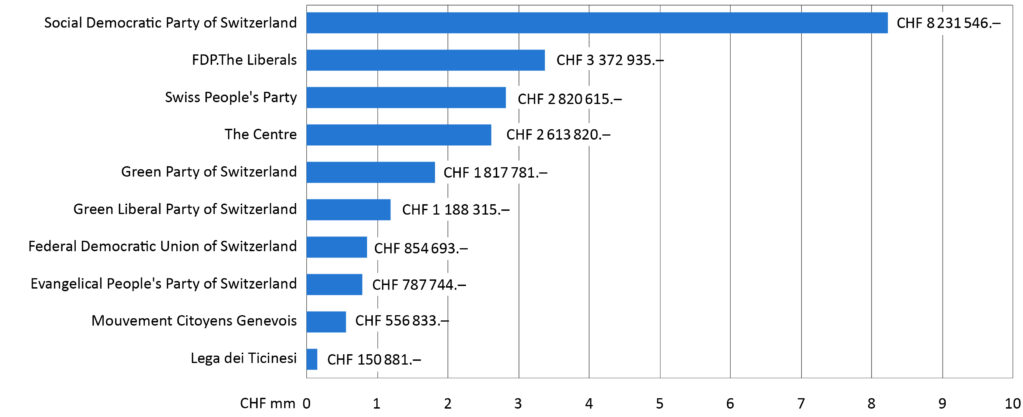
The total receipts of Federal Council parties ranged between CHF 2.6 million and CHF 8.2 million
The parties’ total receipts of CHF 22.4 million for the 2024 calendar year were around CHF 3.9 million lower than in the previous year (2023: 26.3 mn). The Swiss Social Democratic Party (SP) recorded the highest total amount of receipts at CHF 8.2 million (2023: 9.0 mn). FDP.The Liberals (FDP) had receipts of CHF 3.4 million (2023: 3.5 mn, originally 4.2 mn was disclosed), the Swiss People’s Party (SVP) CHF 2.8 million (2023: 3.9 mn, originally 5.9 mn was disclosed) and The Centre CHF 2.6 million (2023: 3.1 mn). The receipts of The Greens (1.8 mn) and the Green Liberals (1.2 mn) also exceeded the million mark. Further receipts were reported by the Federal Democratic Union (EDU), the Evangelical People’s Party (EVP), the Mouvement Citoyens Genevois (MCG) and the Lega dei Ticinesi (LdT).
Differences in the amount of member and mandate contributions
The amount of receipts from member and mandate contributions depends on the number of members, mandates and internal party regulations. As in the previous year, there were differences between the parties; the respective amounts were similar to the previous year’s figures: the highest member contributions were received by the SP (2.1 mn), followed by the EVP (0.5 mn) and The Greens (0.4 mn). In terms of mandate contributions, the SP (0.5 mn) recorded the most receipts, ahead of the SVP (0.4 mn) and The Greens (0.4 mn) (see chart on 2024 party funding figures).
The list of political actors audited has been published
The SFAO has also published a list of the political actors subjected to a material audit. It audited three parties at random, with a receipts volume of CHF 7.4 million. This corresponds to 33% of the total amount of annual receipts submitted. The SFAO is not authorised to provide information on audit findings. If a legally binding conviction has been passed down, the SFAO adds a reference to this judgment, without further comment, to the corresponding entries in the electronic register.
| Party funding: scope of the duty of disclosure and informative value of the figures |
| Aside from receipts from donations, receipts from events, the sale of goods and services and mandate and member contributions must also be disclosed – but not parliamentary group contributions. National parties that are represented in the Federal Assembly are required to disclose their receipts. Only their national sections, not their sections at cantonal and communal level, are subject to the duty of disclosure. The picture varies greatly depending on how the party’s work is organised. If, for example, member contributions are paid to cantonal sections, this does not appear in the register. The following applies to disclosure: in the case of donations made to the party by a party-affiliated organisation, the originator must have intended to support the party represented in the Federal Assembly with the donation, regardless of to whom the donation was originally made. This intention must have been apparent to the party with a reasonable amount of clarification. If this is not cumulatively the case, a party does not have to disclose the original source. Party funding for a calendar year does not provide an overall picture of a party’s political funding for the current year or its assets, but rather reflects a party’s receipts in a given calendar year. The 2023 and 2024 figures show that parties are funded in different ways. |